Sunday, October 19, 2014

Chapters Thirteen & Fourteen Reading Questions

On Monday we'll catch up on Chapter 12 (see previous post for reading questions). For Wednesday, please read Chapters 13 and 14 and be prepared to answer the following questions:

Chapter 13
  • How did the Cold War effect immigration and immigration policy?
  • What was surprising about who was admitted under the Displaced Persons Act of 1948? 
  • What did President Truman say was the greatest vice of the quota system and what was he specifically referring to?
  • While immigration policy was still focused on Europe, who was really immigrating to the U.S. in larger numbers and why?
  • What was revolutionary about the Immigration Act of 1965 and how did it fit with the national mood?
  • What were the unanticipated results of the 1965 law?
  • What is parole authority and how does it relate to the Refugee Act of 1980.
  • How does a refugee differ from an asylee?
  • How did American attitudes toward refugees change between WWII and 1980?
  • What was the Mariel Crisis and how did it compare with Haiti's boat people?
  • What's so interesting about the numbers of legal immigrants and the quota limits?
Chapter 14
  • What three things does Daniels say brought about a change in attitude towards Asian immigrants?
  • What characteristics have led to Asian Americans being called the model minority?
  • What are ABCs and FOBs and who are the "silent" Chinese of San Francisco?
  • What are the three distinct increments of Filipino immigration?
  • What profession niche do recent Filipino immigrants dominate and why?
  • Who were the Koreans who came before the 1965 immigration act?
  • What do Indian and Korean immigrants have in common?
  • How and why do Vietnamese immigrants differ from other recent Asian immigrants?
  • What was the total number of Vietnamese War refugees and their children, and what nationalities are included?
  • Compare the population growth of Chinese, Japanese, Filipino, Indian, Korean, and Vietnamese Americans since 1965. What accounts for the differences?

Tuesday, October 14, 2014

Midterm Questions II

The Midterm Exam will be on Wednesday, 10/15. It will consist of three (3) essay questions that will cover broad themes of immigration and ethnic history. The questions will require you to include evidence from more than one chapter of the textbook. The questions will take 15 minutes to answer on average. The exam will be open-book and open-note. 

The questions are
  1. What are the three myths of American immigration, and what are the real "laws" or tendencies?
  2. Outline key immigration legislation up to World War II, and explain the what, when, and why of it.
  3. What factors contribute to the cultural persistence of an ethnic group, and what factors lead to loss of cultural identity/assimilation? (give examples)

Friday, October 10, 2014

Midterm Questions

The Midterm Exam will be on Wednesday, 10/15. It will consist of three (3) essay questions that will cover broad themes of immigration and ethnic history. The questions will require you to include evidence from more than one chapter of the textbook. The questions will take 15 minutes to answer on average. The exam will be open-book and open-note. 

Here are suggestions questions/topics for the exam from today's class meeting:
  1. Laws/tendencies of immigration
  2. Refugees
  3. Myths of immigrations (related to #1)
  4. Why do some ethnic groups assimilate while others' cultures persist?
  5. Immigration legislation: what/when/why?
  6. Nativism: when and why?
  7. British cultural domination and Angloconformity
  8. How has the "means" changed
  9. Involuntary immigration
  10. Chronology of immigration--who came when
  11. Patterns of jobs and businesses of immigrants 
Please review these topics this weekend. We will finalize the questions on Monday.

Monday, October 6, 2014

Chapter Twelve Reading Questions

For Wednesday, please read Chapter Twelve and be prepared to answer the following questions:

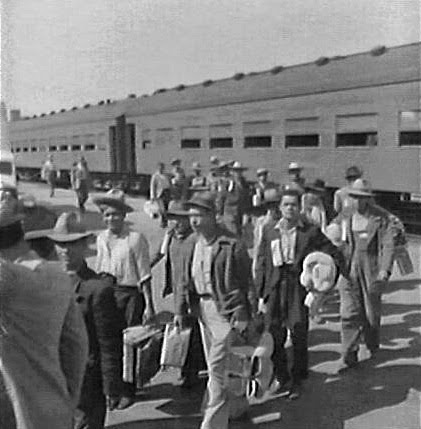
  • Why is 1909 a significant date for Mexican immigration?
  • How did the U.S. deal with Mexican immigrants during the Great Depression?
  • How many Mexicans were in New Mexico and California when the U.S. annexed the territory?
  • Why was statehood delayed?
  • Why is all but impossible to get accurate estimates of the number of immigrants from Mexico (long list).
  • Why is the relative standard of living in Canada, the U.S. and Mexico important?
  • During World War I, who filled the jobs that otherwise might have been filled by European immigrants in places like Chicago, Detroit, and Pittsburgh?
  • What was the bracero program, and why was it created? 
  • What percentage of illegal immigrants are Mexicans today? What messes up the numbers?
  • What accounts for the low rate of naturalization for Mexican Americans? For language persistence?
  • How did the United Farm Workers movement combine religion and politics?
  • What is the status of Puerto Rico and Puerto Ricans? 
  • Why do most Puerto Ricans not want independence?
  • Where do most Puerto Ricans live?
  • What two related problems to Puerto Ricans face in the United States?
  • How are Puerto Ricans more like earlier European immigrants than like Mexican immigrants?
  • What common phenomenon do both groups suffer from?


Friday, October 3, 2014

Ancestry Project & Chapter Eleven Reading Questions

The immigration documents project: You will mine the Ancestry.com database available on campus at http://ancestrylibrary.proquest.com for information about an immigrant or immigrant family and write a report on what you find and how it compares to what you have learned from the textbook. The report should be roughly 2,000 words and should include full citations of the records you use from the databases (census, passenger list, death index, etc.). Please print out copies of the documents and include them with your report. This project is due on Monday, 10/27. Students will share their research findings over the course of the week of 10/27.

Link to Video
Chapter Eleven Reading Questions:
For Monday, please read Chapter Eleven and be prepared to answer the following questions:
  • How did immigration and emigration numbers change in the period 1921-1945 and why?
  • The greatest increase in post-World War I immigration came from where?
  • What were the three reasons for actual immigration running well over the 150,000 annual quota in the first six years of the National Origins policy?
  • How was the LPC (Likely to become a Public Charge) clause used during the Great Depression?
  • How did the U.S. government deal with the refugee crisis of World War II? Give examples.
  • During World War II, how were "enemy aliens" treated?
  • Describe Japanese internment (numbers, duration, location, recent government response, etc.)
  • How did the Chinese in America benefit from World War II? What were the demographic consequences?

Monday, September 29, 2014

Chapter Ten Reading Questions

For Wednesday, please read Chapter Ten and be prepared to answer the following questions:

  • What is Nativism and what causes it?
  • What and when were the three discreet phases of anti-immigrant activity?
  • What was the Know-Nothing party?
  • What does the Fourteenth Amendment to the Constitution establish? Who's left out?
  • Why did the Chinese Exclusion Act pass?
  • What prompted the federal government to take over the administration of immigration?
  • What do you know about Ellis Island?
  • Against whom was most racism directed and why?
  • Was the literacy test effective at barring undesirable immigrants?
  • How did the depression of 1890 and World War I effect public opinion on immigration?
  • How did the quota plan work? who was not subject to it?
  • In 1924, what were some of the conflicts and struggles felt by the relatively prosperous nation?
  • Was a limit on immigration necessary or desirable?

Wednesday, September 24, 2014

Chapter Nine Reading Questions

When reading Chapter Nine for Monday, please consider the following questions:

  • What brought Chinese immigrants to the United States? 
  • How does Daniels define "immigrant," and what does he consider to be "the false and essentially racist notion" of some scholars?
  • What was the "coolie trade"?
  • Where did the Chinese settle and how did they finance their migrations?
  • How did Chinatowns differ from other American ethnic enclaves?
  • What are the Naturalization Act of 1870 and the Chinese Exclusion Act of 1882?
  • What is a "paper son"?
  • Where did Japanese immigrants settle, and what occupations did they have?
  • Why were the Japanese initially treated differently from the Chinese, and how did that affect their demographics?
  • What is the "Gentlemen's Agreement of 1907-8"?
  • What is a "picture bride marriage," and was it unique to the Japanese?
  • Why did Carroll Wright say that French Canadians were the "Chinese of the Eastern States"?
  • How was French Canadian migration unique?
  • What were French Canadian occupations in Canada, and what were they in the United States?
  • Why was French Canadian acculturation so much slower than for any other immigrant group?